

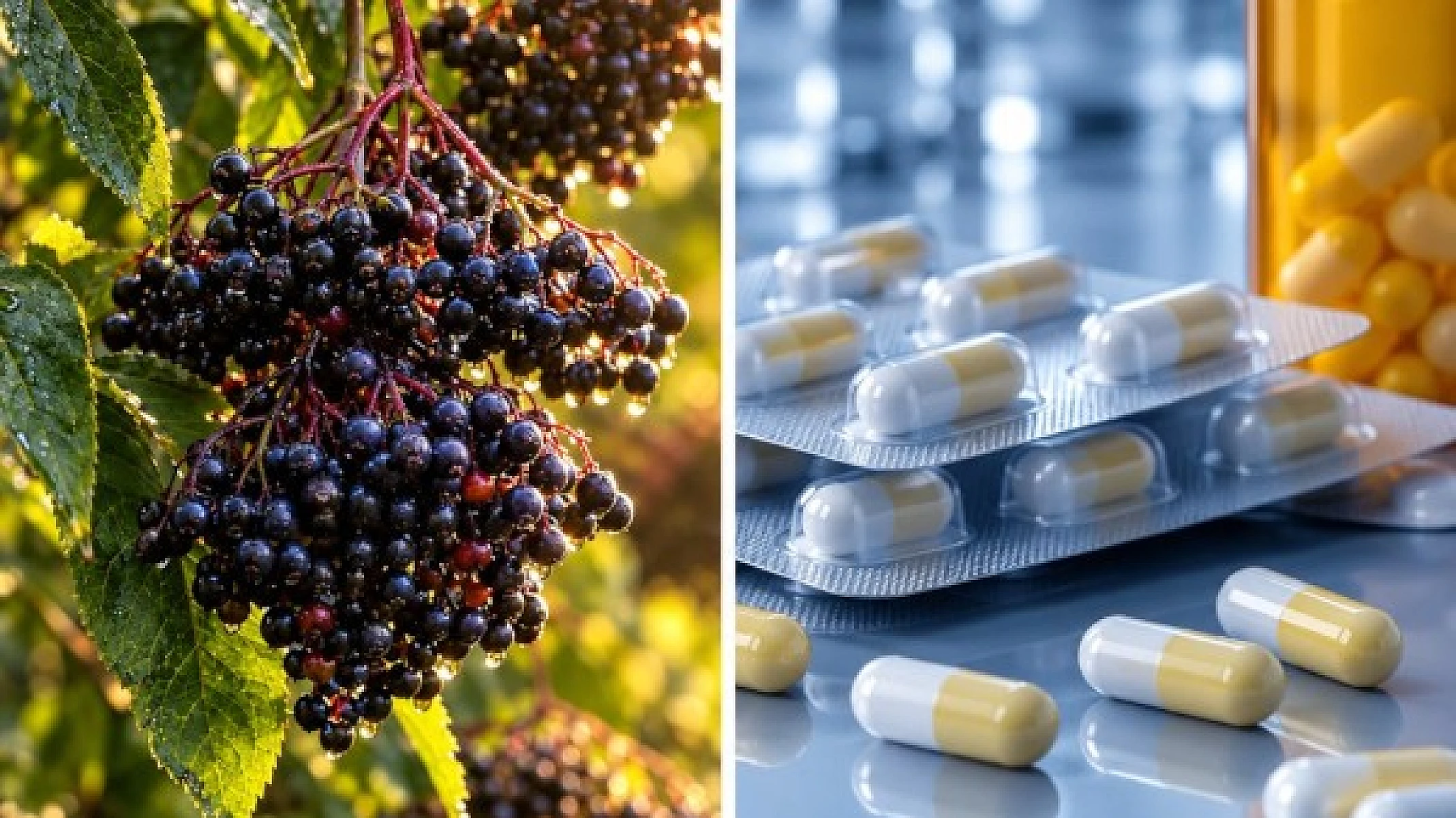
Originally published on https://read.sayerji.com Why I reached for a berry instead of Tamiflu, and why the flu may be something your body needs to finish, not something to shut down
The Catalyst
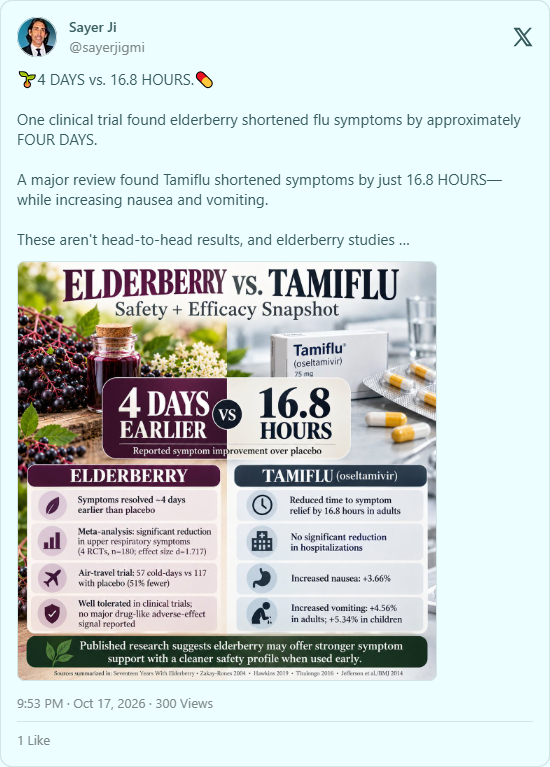
This week, emergency physician Dr. Mark Trozzi published a piece titled Elderberry Extract: Nature’s Answer to Influenza. It’s clear and well sourced, and it pulls together something I’ve been writing about since GreenMedInfo’s earliest days: in placebo-controlled trials, standardized black elderberry extract cut flu symptoms by days, while Tamiflu’s best showing in its own trials is measured in hours.
Dr. Trozzi’s article landed at a personal moment. I had just come through my own bout of flu, and elderberry was the main tool I used. So I’m treating his piece as an invitation to do two things I’ve put off for too long. The first is to tell you what happened. The second is to collect seventeen years of my own reporting on elderberry, Tamiflu and the flu in one place.
What Happened to Me
A few weeks ago, I started to feel myself come down with symptoms that sometimes precede full-blown flu for me: higher body temperature, malaise, chest cough, and a sense that my body was ‘fighting something,’ which is a signal that I need to reset, detoxify, and perhaps disengage from my normal high-paced work schedule. I’ve written about the flu being the body’s emergency reset, if you want another perspective on the ‘seasonal flu.’
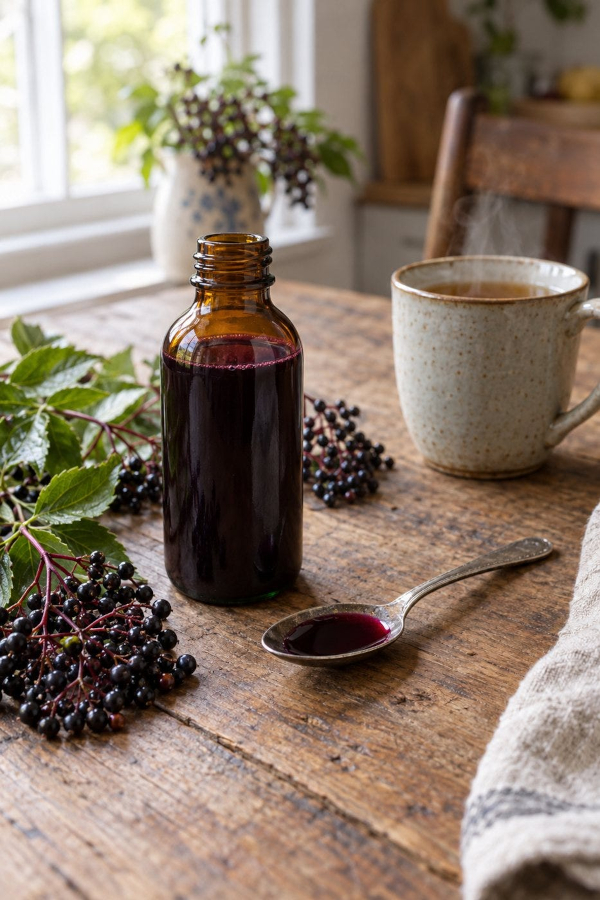
Elderberry syrup at the kitchen table. Illustration.
My favorite elderberry concentrate is Gaia Herbs Black Elderberry Syrup. I always have a few bottles in the cabinet for just such an occasion. According to Gaia, the berries come from a certified organic cooperative and are “juiced, concentrated, and passed through a patented membrane filtration system to produce a highly concentrated extract,” with each teaspoon equal to about 15 grams of fresh elderberries.
One honest note, because Dr. Trozzi raises it and he’s right to: the berry products in the store aren’t all the same. The two best-known clinical trials used a specific standardized extract (Sambucol), and the researchers warned that many commercial products contain very little of the flavonoids they believed were doing the work. Gaia’s syrup is a concentrated organic elderberry product, not that exact trial formula. My experience is one person’s experience, not a trial. But it fits closely with what the trials found, and with what I’ve watched readers report for almost two decades.
Seventeen Years in the Archive
I started GreenMedInfo in 2008. Within a year, H1N1 “swine flu” had governments around the world buying Tamiflu by the hundreds of millions of doses. That was when elderberry first caught my attention as a research subject rather than a folk remedy. (More on what I wrote that summer below.)
The study that hooked me came out in August 2009, right in the middle of the panic. Researchers writing in Phytochemistry found that elderberry flavonoids bind to H1N1 virions and block them from infecting host cells. They added a line that stopped me cold: the H1N1-inhibiting activity of these berry compounds “compare[s] favorably” to Tamiflu (oseltamivir) and amantadine.
The numbers: One elderberry flavonoid inhibited H1N1 with an IC50 of 0.36 µM, compared with 0.32 µM for Tamiflu. In a test tube, they were roughly equal in potency. (Roschek et al., Phytochemistry, 2009)
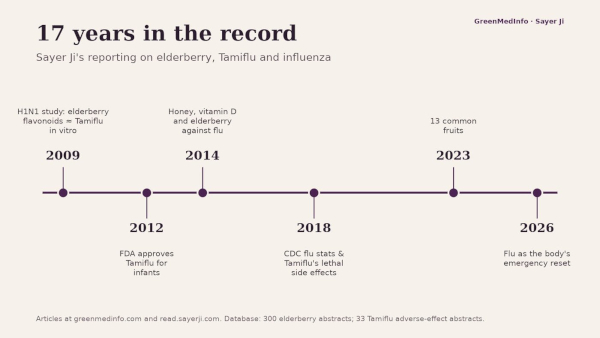
Seventeen years of reporting on elderberry, Tamiflu and influenza.
That study became a recurring reference in my work. Here’s the trail:
2009: In my August email update, Special Flu Report: When Pigs Fly, I questioned the swine flu pandemic and opened GreenMedInfo’s first research sections on natural neuraminidase and hemagglutinin inhibitors.
2012: I reported that the FDA had approved Tamiflu for infants as young as two weeks old. I cited a 2010 Pediatric Infectious Disease Journal study in which 84 of 157 Tamiflu-treated infants (54%) had recorded complications, and a 2011 proportional-mortality study of 119 deaths after Tamiflu was prescribed, 38 of which deteriorated within 12 hours.
2014: In Honey Found To Have Potent Anti-Influenza Activity, I placed elderberry alongside manuka honey and vitamin D as natural flu tools, including the finding that elderberry relieved symptoms an average of four days earlier than placebo.
2018: In The CDC’s Fictional Flu Death Stats and Tamiflu’s Lethal Side Effects, I described a report of 80 deaths linked to Tamiflu, 50 of them sudden deaths or deaths from sudden cardiopulmonary arrest. Those are the same heart and lung causes usually written down as “flu deaths.” I also covered rat data showing that brain concentrations of the Tamiflu prodrug in 7-day-old animals were about 1,500 times higher than in adults given the same dose.
2018: In The Shocking Lack of Evidence Supporting Flu Vaccines, I listed elderberry, citing the 1995 trial, among the evidence-based, non-prescription prevention strategies.
2023: In The Amazing Healing Properties of 13 Common Fruits, I came back to the 2009 finding that elderberry flavonoids compare favorably with Tamiflu.
2026: In WHO’s Latest Prescription for Failure, I argued that elderberry, colostrum, vitamin D and other “pathogen-agnostic” tools stay out of policy discussions despite the published evidence. In What If Flu Season Is the Body’s Emergency Reset? and How Being Poisoned Can Be Mistaken for Being Infected, I laid out the terrain framework this article builds on.
This week: In They Compared the Spice to the Drug. The Spice Won., the echinacea-and-elderberry versus Tamiflu trial made my list of ten head-to-head comparisons: governments stockpiled billions of dollars of Tamiflu, and elderberry costs about twelve dollars.

The paper trail. Illustration.
Meanwhile, the GreenMedInfo elderberry database has grown to 300 indexed research abstracts. The Tamiflu (oseltamivir) adverse-effects file holds 33. Our contributors have written on this too: Linda Woolven and Ted Snider, the GMI Research Group, and Pat Robinson’s 43 Natural Alternatives for Colds and Flu.
Where It Started: When Pigs Fly
While writing this, I went back to find the first thing I ever published about influenza. It was my August 2009 GreenMedInfo email update, Special Flu Report: When Pigs Fly. I was managing a health food store at the time. GreenMedInfo was halfway to its goal of 10,000 indexed studies, and the United States was preparing a fall swine flu vaccination campaign.
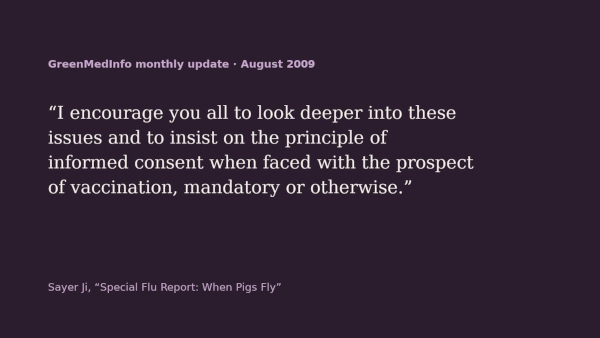
From the August 2009 GreenMedInfo update.
Rereading it seventeen years later, two things stand out. The first is that the instinct behind this article was already there. In that newsletter I opened new GreenMedInfo sections for natural “neuraminidase inhibitors” and “viral hemagglutinin inhibitors.” Those are the two surface proteins that put the H and the N in H1N1. Tamiflu blocks neuraminidase. That same summer, the Phytochemistry study found elderberry flavonoids bind the H1N1 virus and stop it from entering cells. I also wrote that “certain infections are representative of basic dietary deficiencies of certain phytonutrients we no longer commonly eat.” That line was an early version of the terrain view I hold today.
The second is a scorecard. I made a lot of claims in that newsletter. Some held up better than I could have known at the time. Some didn’t, and I’ll say which.
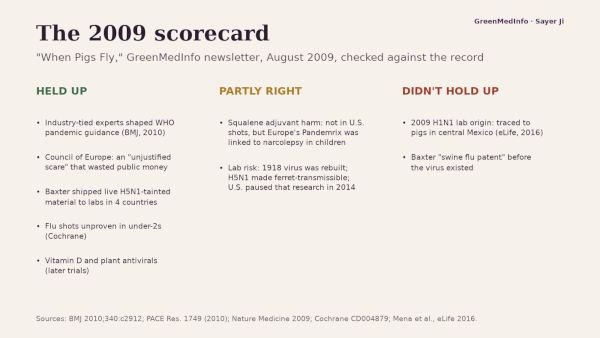
The August 2009 newsletter, checked against the record.
What held up
The definition moved. For years, WHO’s pandemic preparedness page described a pandemic as causing “enormous numbers of deaths and illness.” On May 4, 2009, about five weeks before WHO declared the H1N1 pandemic, that phrase was removed. WHO later said the wording was never its formal definition. Peter Doshi’s review in the Bulletin of the World Health Organization concluded that WHO had never formally defined pandemic influenza at all.
Industry was in the room. In June 2010, an investigation by the BMJ and the Bureau of Investigative Journalism found that scientists who helped write WHO’s guidance on pandemic antivirals and vaccines had consulted for Roche, the maker of Tamiflu, and GSK, without WHO disclosing it. WHO kept the names of its pandemic Emergency Committee secret until after the pandemic was declared over.
Europe called it a scare. The Council of Europe’s Parliamentary Assembly found that the response led to a “waste of large sums of public money and unjustified scares and fears” and cited “grave shortcomings” in transparency.
The Baxter incident was real. Months before the pandemic, Baxter’s research lab in Austria sent flu material contaminated with live H5N1 bird flu to labs in Austria, the Czech Republic, Slovenia and Germany. It was caught only when ferrets injected with it fell severely ill.
Flu-shot evidence for babies was thin. Cochrane reviewers found little evidence for influenza vaccines in children under two, and only one safety study of the inactivated vaccine in that age group, “carried out nearly 30 years ago in 35 children.”
Vitamin D was a real lead. I suggested vitamin D deficiency might be the “seasonal stimulus” behind flu. The next year, a randomized trial in Japanese schoolchildren found that 1,200 IU daily cut influenza A from 18.6% to 10.8%. A 2017 BMJ meta-analysis of 25 trials confirmed protection against respiratory infections, strongest in people who were most deficient.
What was partly right
Adjuvants. I wrote that the swine flu vaccine “millions of Americans will take this fall” contained squalene. For the U.S., that was wrong: none of the U.S. H1N1 vaccines contained an adjuvant. In Europe, though, GSK’s adjuvanted Pandemrix was later linked to narcolepsy in children and teens: a 6.6-fold higher risk in Sweden and 12.7-fold in Finland, or about 1 in 20,000 vaccinated. The specific claim missed. The warning about fast-tracked, adjuvanted pandemic vaccines did not.
Lab risk. I wrote about the 1918 virus being rebuilt and tested in monkeys. Two years later, two labs made H5N1 bird flu transmissible between ferrets, and in 2014 the U.S. paused funding for that kind of research. Many researchers now consider the 1977 “Russian flu” the likely result of a lab escape or a live-vaccine trial.
What didn’t hold up
The origin of H1N1. I leaned on virologist Adrian Gibbs’s suggestion that the virus came from a lab. WHO’s experts rejected it within days, and a 2016 genetic study traced the virus to pigs in central Mexico, where it emerged through the long-distance live swine trade. On the evidence, the 2009 virus was natural. If anything, it points back to the terrain of industrial animal farming.
The Baxter “patent.” I repeated a claim that Baxter had patented a swine flu vaccine before the virus existed. I can’t find support for it, and I shouldn’t have passed it along.
Motives. I also speculated about motives, including population control, that I can’t support with evidence and wouldn’t write today.
I’m publishing this scorecard because the method matters more than any single call. The parts that held up were grounded in documents: disclosures, contracts, trial data. The parts that didn’t were speculation about origins and intent. That’s the standard I’ve tried to hold myself to since.
What the Elderberry Trials Show
1995, Israel. During an influenza B outbreak, a double-blind, placebo-controlled trial of standardized elderberry extract found that most people taking elderberry were significantly better, fever included, within two days. Most on placebo took close to a week.
The numbers: 93.3% of the elderberry group improved significantly within 2 days, compared with 91.7% of the placebo group within 6 days. Nearly 90% of the elderberry group recovered completely within 2 to 3 days. In the lab, the extract stopped several influenza A and B strains from replicating. (Zakay-Rones et al., J Altern Complement Med, 1995)
2004, Norway. In 60 patients whose influenza was confirmed by lab testing, elderberry syrup relieved symptoms about four days earlier than placebo, with less need for rescue medication and no treatment-related adverse events.
The numbers: 15 mL of elderberry syrup four times daily for 5 days, compared with placebo; relief came an average of 4 days sooner. (Zakay-Rones et al., J Int Med Res, 2004)
2009, Shanghai. A proprietary elderberry extract given to patients with flu-like illness “can rapidly relieve influenza-like symptoms,” according to the author, who called it similar or superior to antiviral drugs.
2015, head-to-head against Tamiflu. In a double-blind trial, an echinacea and elderberry hot drink matched oseltamivir and edged it slightly, with fewer complications and side effects.
The numbers: Recovery by day 10 was 90.1% in the echinacea-elderberry group and 84.8% in the oseltamivir group. (Raus et al., Curr Ther Res Clin Exp, 2015)
2021, systematic review. A systematic review found that elderberry shortened illness by nearly three days compared with placebo. It also found that, compared with oseltamivir, an elderberry-containing product “may be associated with a lower risk of influenza complications and adverse events.” The reviewers called the evidence promising but limited in size and quality.
I’m not going to hide the trial that cuts the other way. A 2020 emergency-room trial in patients aged five and up found no benefit from elderberry, and its authors said the result contradicted earlier studies. That trial enrolled patients who had already reached the emergency room, and many were taking oseltamivir at the same time. To me, that points to the real lesson, and it’s the one the 1995 and 2004 trials teach too: elderberry works best early, in adequate doses, and as part of supporting the body’s own process, not as a last-ditch rescue drug.
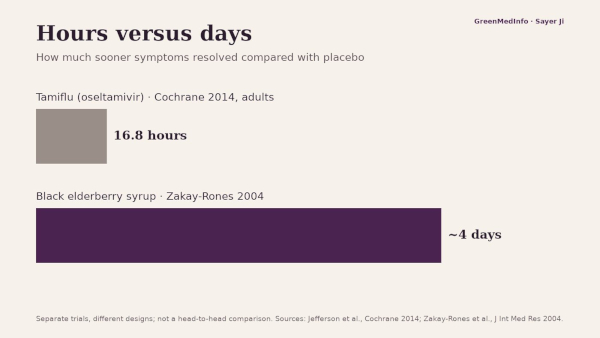
Symptom relief compared with placebo: hours for Tamiflu, days for elderberry. Separate trials; not head-to-head.
What the Tamiflu Record Shows
Tamiflu’s case was never strong. When the Cochrane Collaboration finally got access to the full clinical study reports after years of pushing, it found that oseltamivir shortened symptoms in adults by about 16.8 hours, with no significant reduction in hospital admissions. That is less than a day out of a seven-day illness.
The drug’s own FDA label warns of “abnormal behavior, delirium, including symptoms such as hallucinations, agitation, anxiety, altered level of consciousness, confusion, nightmares, delusions,” mostly in children and sometimes with fatal outcomes. The label says the drug’s contribution “has not been established.” A 2025 meta-analysis of observational data did not find an increased neuropsychiatric risk, so the question is still contested. The warning is still on the label.
Illustration.
The story changed this year. In June 2026, the REMAP-CAP international adaptive trial reported that critically ill flu patients given oseltamivir were more likely to die than those given no antiviral. Their message to the public was blunt: “patients with severe flu who need to be admitted to an ICU should not receive oseltamivir, even though it is currently part of standard care.”
The numbers: Among 442 critically ill patients, 90-day mortality was 19.4% with oseltamivir and 13.7% without an antiviral. Investigators estimated a greater than 98% probability of harm in this group. (REMAP-CAP, June 2026)
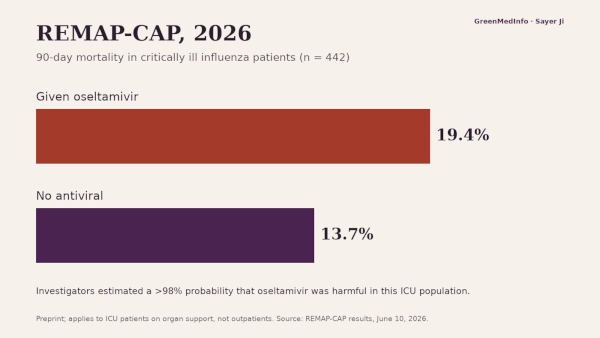
REMAP-CAP 2026: 90-day mortality among critically ill influenza patients.
In July, the European Medicines Agency opened a formal safety review. Australia’s living guideline now recommends stopping oseltamivir once critical illness develops.
To be precise: the REMAP-CAP results are from a preprint, and they apply to ICU patients on organ support, not to outpatients. Even critics who urge caution, though, agree that routine oseltamivir in the sickest flu patients “deserves immediate reconsideration.” The patients who were supposed to justify the stockpiles are the ones the first rigorous randomized data now suggest may be harmed.
Seventeen Years of Pandemics of Opportunity
What 2009 taught me is that you don’t need a manufactured virus to get a manufactured emergency. You need a declaration, a fear narrative and a market for countermeasures that’s already waiting. The virus can be entirely natural. The opportunity is what gets engineered.
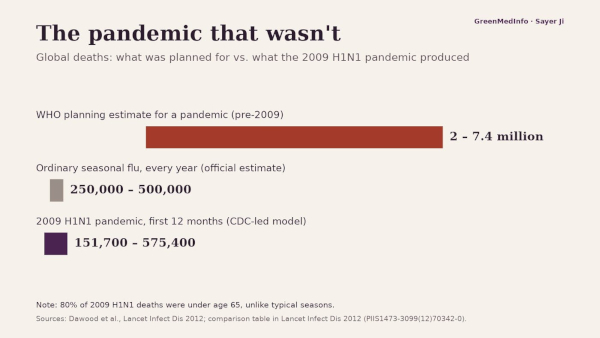
What was planned for versus what the 2009 H1N1 pandemic produced.
Measured against what had been planned for, the 2009 pandemic barely registered. WHO’s pre-2009 planning estimate was 2 million to 7.4 million deaths. The CDC-led estimate for H1N1’s first year was 151,700 to 575,400, close to the 250,000 to 500,000 deaths of an ordinary flu season. The burden did fall more on younger people, with 80% of deaths under age 65, and that’s real. But it was not the catastrophe that the contracts, the stockpiles and the fear were built for.
I’ve watched the same pattern repeat:
2009, swine flu: The declaration triggered vaccine contracts and Tamiflu stockpiles, guided by advisers with undisclosed ties to the drugmakers. The full trial data later showed Tamiflu shortened symptoms by less than a day.
2014, Ebola: While I was reporting on natural compounds studied against Ebola, the UN Security Council for the first time declared a disease outbreak a threat to international peace and security, as I later traced in Endless Pandemics as a Failed Global Governance Model.
2020, COVID-19: In The Real Pandemic Profiteers, I documented how the largest corporate winners were never called profiteers, while critics who talked about those profits were.
2024, bird flu: GreenMedInfo covered mass poultry culls in an outbreak that, as Joel Salatin put it, starts again and again in concentrated animal feeding operations.
October 2026, plague: In The Plague Panic & Vaccines Were Ready Before the Diagnosis, I showed how one unexplained death in Siberia, with no confirmed plague diagnosis and no secondary cases, produced Black Death headlines and vaccine stock gains within days. A week later, the UN General Assembly adopted a pandemic declaration by 153 votes to 3 that commits governments to counter health “misinformation” and never mentions freedom of expression or informed consent.
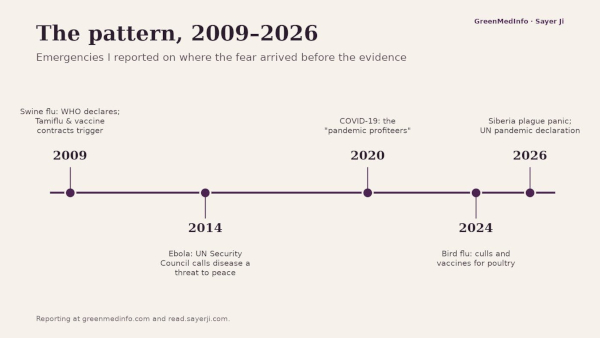
Emergencies where the fear arrived before the evidence.
That’s why the most important question in this article isn’t “Which antiviral?” When the emergency is declared before the evidence arrives, the protection that matters most is the one no declaration can take away: a body that’s prepared, and the informed consent to decide what goes into it. I wrote that in 2009. I’d write it the same way today.
Does Your Body Need This Flu?
This is where I part ways with both the pharmaceutical model and the “natural antiviral” model, which often copies the same logic with a gentler molecule.
In What If Flu Season Is the Body’s Emergency Reset?, I argued that influenza-like illness can be read as a host-led program: a coordinated acute-phase reset driven by immune signaling, metabolic cleanup, circadian timing and the ancestral inputs modern life has stripped away. These include UVB light, swings between heat and cold, hard exertion and real rest. Fever, loss of appetite, sleepiness and withdrawal are metabolically expensive. They look designed, not accidental. As I wrote in REGENERATE, the so-called sickness syndrome may be one of the last ways a modern body can force itself to stop, rest and repair.

Rest is part of the process. Illustration.
If that’s even partly true, the first question when flu symptoms show up shouldn’t be “How do I shut this down?” It should be “What is my body trying to finish, and how can I help it finish cleanly?”
That’s why the mechanism matters. Tamiflu targets one viral enzyme, neuraminidase. In my 2012 reporting I raised the concern that the drug may also cross-react with the body’s own neuraminidase (sialidase) enzymes, which could help explain its neurological signals. Fever reducers add another layer. As I documented in How Being Poisoned Can Be Mistaken for Being Infected, suppressing fever increased influenza deaths in animal studies, and acetaminophen depletes glutathione, the very reserve the immune response relies on.
The numbers: A meta-analysis of animal models found a pooled odds ratio of 1.34 for influenza mortality with fever suppression.
Elderberry works differently. It doesn’t flatten the fever or override the process. In the trials, fevers resolved faster, not because they were suppressed but because the illness moved through to its end sooner. In my own experience, it felt less like stopping the flu and more like letting it do its work in two days instead of seven.
Prepare Before It Arrives
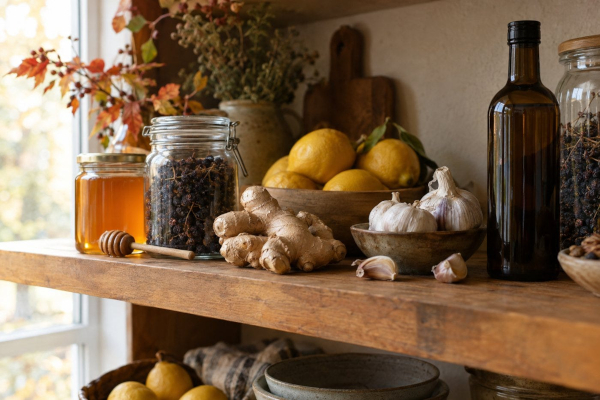
A flu-season pantry. Illustration.
The best flu strategy starts before the first chill:
Keep a quality elderberry product at home before you need it. The trials point to early use, within the first 24 to 48 hours. Know your product, read its label, and understand the difference between a concentrated extract and plain juice.
Restore the missing pulses. Get morning outdoor light, keep regular sleep, use sauna or hot baths, try cold contrast where it’s safe for you, and do hard efforts with real recovery. Frequent sauna bathing is associated with lower risk of pneumonia and all-cause mortality in large Finnish cohorts.
Cover the terrain basics. Vitamin D at 1,200 IU daily cut influenza A in schoolchildren from 18.6% to 10.8%, a 42% reduction, in a 2010 randomized trial I have cited for years. Manuka honey, colostrum, echinacea and green tea all have published support.
Don’t reach for a fever reducer by reflex. A moderate fever that’s being tolerated may be doing important work.
When it comes, let it. Rest, sweat, hydrate, eat lightly, and give your body the time it’s asking for.
When not to wait
None of this means ignoring danger signs. Get medical care right away for trouble breathing, chest pain, confusion, a fever that won’t come down or keeps climbing, signs of dehydration, or symptoms that improve and then come back worse. The same applies to infants, pregnant women, the frail elderly and anyone who is immunocompromised. Working with your body includes recognizing when it needs help.
The Real Question
For seventeen years, the official answer to the flu has been a shot that misses most flu-like illness and a pill whose benefit is measured in hours. As of this year, that pill’s sickest patients appear to fare worse on it.
Meanwhile, a purple berry used for centuries has kept showing up in trials, with days of benefit instead of hours, few adverse events and a price of about twelve dollars. My thanks to Dr. Trozzi for putting it back in front of people this week.
The deeper shift isn’t from one antiviral to another. It’s from seeing the flu as an enemy to seeing it as information: a signal about the state of our terrain, and in many cases a reset the body is trying to complete. Prepare for it. Support it. Get help if it turns dangerous. And give your body the respect it has earned over countless generations.
This article is for research and informational purposes only. It is not medical advice, diagnosis or treatment. Consult a qualified practitioner before starting or stopping any medication. Not all elderberry products are equivalent, and many are not recommended during pregnancy. Raw elderberries, leaves and stems should never be eaten.


Comments
Sign in or create a free account to join the conversation.
Sign in to commentBe the first to comment.